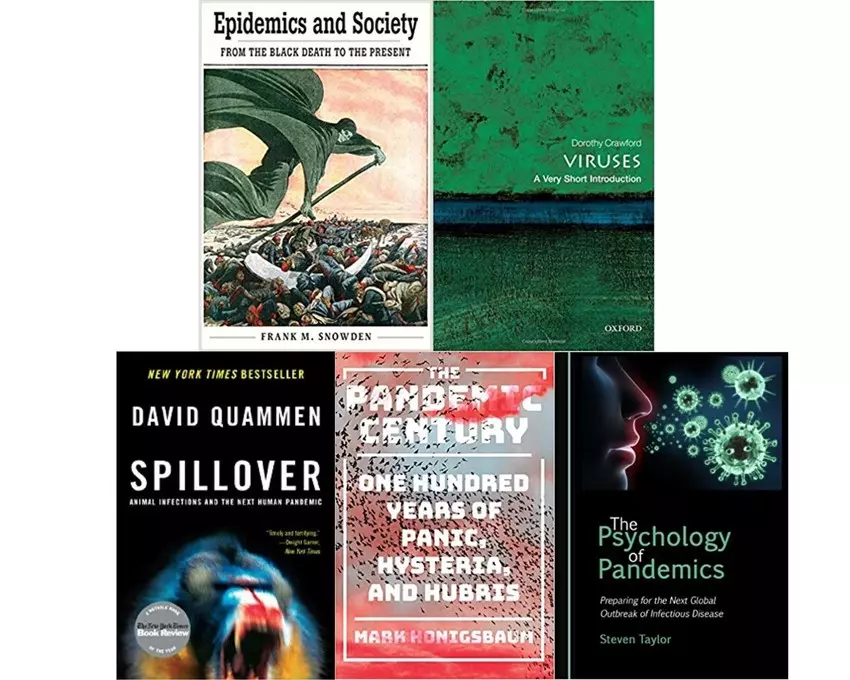
5 books to read for context on the coronavirus outbreak. By World Economic Forum.

It’s extremely important to read. But more often depends on the time and the situation you should learn to flex yourself to read what is required at the time period. I started a target by reading a bare minimum of 2 books a month. One would be my favourite book and the other one would be, readers commonly heard this word “must-read”. You should not compromise.

Here, I’m not contracting about reading and the readers preferences. But let me be precise even more. If we are in the economic crisis, we must start learning finance/economics books. Along with your favourite books. We just need to know what is going on around the globe and we need to start learning on the other side too.

I started learning and observing more on the health related news. I knew that, it is my out-of-syllabus. So far my understanding was chaotic to read about the virus even more simultaneously curious to about how this virus causing the people globally and affects the economy too.

Here is where I learn to start. There are enormous books to read during pandemic . Again our individual choices matters. I agree. This is one of the five books to read during pandemic. To know about 5 books and what all the books says. I sincerely encourage you all to visit the source link further.

I personally chosen second book across five books which is VIRUSES A VERY SHORT INTRODUCTION. BY DOROTHY CRAWFORD. So, I’m genuinely admitting I need to know about the virus.

Let’s have a look and let’s know about the pandemic and the virus.

https://assets.weforum.org/editor/responsive_large_webp_W5th8zw28K6hDEP80hrGs82hB_AiC2jEUkFq8fho-s4.webp

SOURCE: https://www.weforum.org/agenda/2020/03/coronavirus-books-pandemic-reading-covid19/

With respect.

Valuable poetry: “Sea Fever” – John Masefield.

About the poet:

https://cdn.britannica.com/s:700×500/41/133541-050-2627FCEB/John-Masefield.jpg

John Masefield

British poet

John Masefield, (born June 1, 1878, Ledbury, Herefordshire, Eng.—died May 12, 1967, near Abingdon, Berkshire), poet, best known for his poems of the sea, Salt-Water Ballads (1902, including “Sea Fever” and “Cargoes”), and for his long narrative poems, such as The Everlasting Mercy (1911), which shocked literary orthodoxy with its phrases of a colloquial coarseness hitherto unknown in 20th-century English verse.

Educated at King’s School, Warwick, Masefield was apprenticed aboard a windjammer that sailed around Cape Horn. He left the sea after that voyage and spent several years living precariously in the United States. His work there in a carpet factory is described in his autobiography, In the Mill (1941). He returned to England, worked for a time as a journalist for the Manchester Guardian, and settled in London. After he succeeded Robert Bridges as poet laureate in 1930, his poetry became more austere.

Other of Masefield’s long narrative poems are Dauber (1913), which concerns the eternal struggle of the visionary against ignorance and materialism, and Reynard the Fox (1919), which deals with many aspects of rural life in England. He also wrote novels of adventure—Sard Harker (1924), Odtaa (1926), and Basilissa (1940)—sketches, and works for children. His other works include the poetic dramas The Tragedy of Nan (1909) and The Tragedy of Pompey the Great (1910), as well as a further autobiographical volume, So Long to Learn (1952). Masefield was awarded the Order of Merit in 1935.

This article was most recently revised and updated by Amy Tikkanen, Corrections Manager.

I must go down to the seas again, to the lonely sea and the sky,

And all I ask is a tall ship and a star to steer her by;

And the wheel’s kick and the wind’s song and the white sail’s shaking,

And a grey mist on the sea’s face, and a grey dawn breaking.

I must go down to the seas again, for the call of the running tide

Is a wild call and a clear call that may not be denied;

And all I ask is a windy day with the white clouds flying,

And the flung spray and the blown spume, and the sea-gulls crying.

I must go down to the seas again, to the vagrant gypsy life,

To the gull’s way and the whale’s way where the wind’s like a whetted knife;

And all I ask is a merry yarn from a laughing fellow-rover,

And quiet sleep and a sweet dream when the long trick’s over.

SOURCES: https://www.britannica.com/biography/John-Masefield-British-poet

https://www.theodysseyonline.com/best-famous-poems-ever-written

With respect.

Valuable lessons: How To Successfully Teach Yourself How To Code.

By Lydia Hallie.

Staying Motivated

Many people asked me how I was able to push myself to code so much on a normal day. It took me a while to find a good way to explain my thoughts behind it, but I think I finally found it!

  • Set small goals.
  • Constantly remind yourself of how far you’ve come already.
  • Work on a personal project you’re actually interested in!
  • Realize that you are doing much better than you think you are.

Things to always keep in mind:

  • Never compare yourself to other developers.
  • You’re making much more progress than you think.
  • Everyone struggles in the beginning, you’re not alone, and that doesn’t mean you will be a bad programmer.

To read full article, I sincerely encourage you to visit further in the below source link.

SOURCE: https://www.freecodecamp.org/news/successfully-teaching-yourself-how-to-code-f6aac23db44a/

With respect.

9 THE BEST BOOKS FOR PROGRAMMING.

If you read just one of these best programming books this year you’ll be a step ahead of nearly everyone around you. That’s because, according to Steve McConnell, the author of Code Compete, one book is more than most programmers read each year.

Author:

Katie Bouwkamp.

BONUS BOOK:

To read the full post, please click the source link down below.

SOURCE: https://www.codingdojo.com/blog/9-best-programming-books-read-right-now-want-distinguish

With respect.

12 Cool Facts About Programming and Coding You Didn’t Know.

· The first programmer in the world was a woman. Her name was Ada Lovelace and she worked on an analytical engine back in the 1,800’s.

· Just as we said before, recent studies have shown that over 70% of coding jobs are in fields outside of technology.

· The first computer virus was created in 1983.

·  The first computer game was created in 1961.

·  The word computer “bug” was inspired by a real bug. It was founded by Grace Hopper in 1947.

·  Nowadays, there are over 700 different programming languages. All experts recommend for kids to start with a visual editor and a blockly based programming language for them to learn in a smoother and easier way.

·  The first programming language (per sé) was called Fortran, and it was created in the ’50s.

·  Almost any powered with electricity needs to be coded. Can you imagine?!

·  Since many programming languages share the same structure, it is easy for students to learn a new programming language once they have already mastered one before.

·  Computers run on binary code, which means that their software is written using only 1s and 0s.

·  Learning coding has stunning cognitive-related benefits, such as problem-solving, computational thinking, analytical thinking, creative thinking, leadership-related skills, and even teamwork.

·  In the near future knowing how to code will be as necessary as knowing how to write is today. Yes, regardless of the field or career your students decide for their future.

If you wanna read about the full article, click the source link in the down below.

SOURCE: https://gocoderz.com/blog/12-cool-facts-about-programming-and-coding-you-didnt-know/

With respect.