Two more bonus required. I think.


With respect.
Two more bonus required. I think.
With respect.


Bonus:

With respect.
Is there something wrong with me?
Or.
I’m really good.
Or.
Am I simply keeping the burden which not at all to be carried?
Or.
Should I really applying the principle “let it go”?
Is it true?
Or false.
Or
Or.
Or.
Or.
These questions arose within me over the last 35 minutes. I believe and I knew I have the answers. I have to learn search within me.
If I could able to arise a questions, definitely I could able to find the answers too.
Respected readers, if you approached my 26 questions.
Will these questions impacted your life?
Please note it down and find an answer within yourself too.
With respect.

Along with the professor Harari’s recommended books. You could see the original article in Guardian.com such as “Books to help you escape lockdown, chosen by Hilary Mantel, Edna O’Brien and more. I sincerely encourage you all to pick any one of the books from the professor Harari/Guardian article.
Also we should not leave professor Harari’s books too.

I personally chosen to read Europe A Natural History by Tim Flannery and Humankind: A Hopeful History by Rutger Bregman and finally, 21 Lessons for the 21st Century by professor Harari.
I will paste the source click down below. You can have a look and read further.
SOURCE: https://twitter.com/harari_yuval/status/1274714812442980354/photo/1
With respect.
It’s extremely important to read. But more often depends on the time and the situation you should learn to flex yourself to read what is required at the time period. I started a target by reading a bare minimum of 2 books a month. One would be my favourite book and the other one would be, readers commonly heard this word “must-read”. You should not compromise.
Here, I’m not contracting about reading and the readers preferences. But let me be precise even more. If we are in the economic crisis, we must start learning finance/economics books. Along with your favourite books. We just need to know what is going on around the globe and we need to start learning on the other side too.
I started learning and observing more on the health related news. I knew that, it is my out-of-syllabus. So far my understanding was chaotic to read about the virus even more simultaneously curious to about how this virus causing the people globally and affects the economy too.
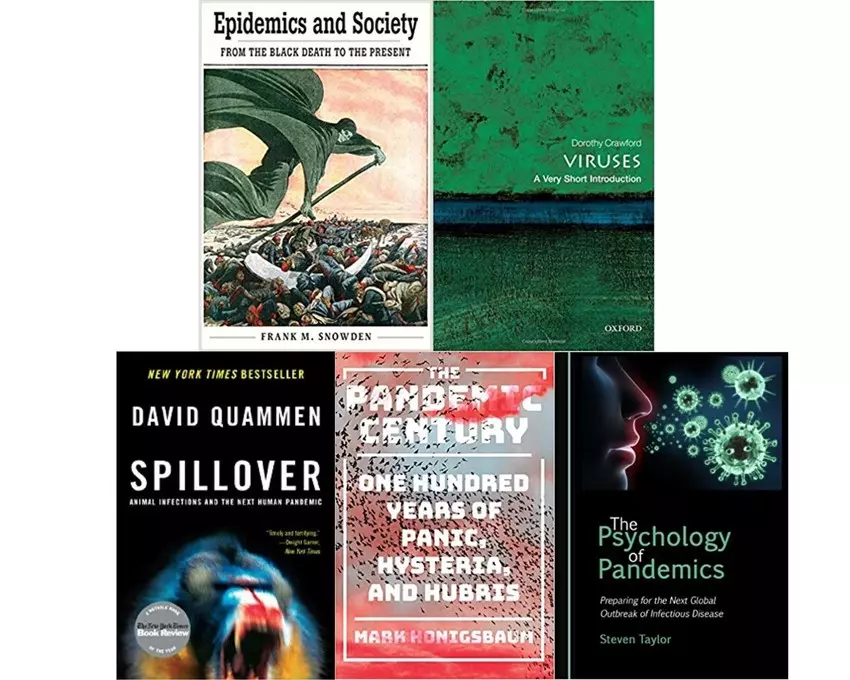
Here is where I learn to start. There are enormous books to read during pandemic . Again our individual choices matters. I agree. This is one of the five books to read during pandemic. To know about 5 books and what all the books says. I sincerely encourage you all to visit the source link further.
I personally chosen second book across five books which is VIRUSES A VERY SHORT INTRODUCTION. BY DOROTHY CRAWFORD. So, I’m genuinely admitting I need to know about the virus.
Let’s have a look and let’s know about the pandemic and the virus.

SOURCE: https://www.weforum.org/agenda/2020/03/coronavirus-books-pandemic-reading-covid19/
With respect.
Foremost, I would like to say how I get to about the ‘most respected and inspired personality Linus Torvalds’. More often I watch more about the IT related videos such as coding and documentary and IT innovators those who created massive impact across the globe. When I started watching the “The Code: Story of Linux Documentary (Multilingual)”. I personally feel I need to watch one more time far more deeper understanding.
It took me more time to think, share and write about this article. Today, I got a good track. Thank you almighty.
Why am I sharing and writing about this article?
One of the trait I see is the leadership skill. I notice and learn very well. Without leadership, a single human cannot do his/her own way. I personally argue, you should learn to take the leadership as a duty and responsibility to lead people in a better way. Also you must ready to step down as a leader for the upcoming generations too. If you are being a leader at a given point of time. Do well and collaborate. Show your interest towards your teammates. This is the far most important quality I started realizing. Leadership is not arrogantly holding momentum. This is what makes me to search leadership quality about the Linus Torvalds.
I sincerely encourage you all to watch the documentary and click the source link down below to read the full article.

About the writer:
Josh Fruhlinger is a writer and editor who lives in Los Angeles.
You don’t have to take a page out of his book to learn some valuable lessons from how Torvalds has managed the sprawling, self-selected, volunteer community of Linux developers—both the successes, and what led to his self-imposed exile.
Do: Be “trustworthy”.
Don’t: Forget that everyone is watching you.
Do: Fight passionately for things you think are important.
Don’t: Go nuclear on the small stuff.
Do: Recognize that emotions are part of the job.
Do: Be consistent.
Do: Recognize that you’re setting the tone.
Don’t: Assume everyone will get to act like you do.
Do: Admit when you might be wrong.
Do: Be graceful about it.
SOURCE: https://www.cio.com/article/3311799/leadership-lessons-from-linus-torvalds-7-dos-and-3-donts.html
With respect.
I rushed myself to write every day. I took in a both good and bad attitude and mind-set. But I would like to be stable/broad and moreover in a sequential too. Started having bad memory too. I must take care. Over the last two weeks, I forgot and missed to post it. But I still love to post it today.
ABOUT THE POET:
Sara Teasdale
American poet.
Sara Teasdale, in full Sara Trevor Teasdale, (born August 8, 1884, St. Louis, Missouri, U.S.—died January 29, 1933, New York, New York), American poet whose short, personal lyrics were noted for their classical simplicity and quiet intensity.
Teasdale was educated privately and made frequent trips to Chicago, where she eventually became part of Harriet Monroe’s Poetry magazine circle. Her first published poem appeared in the St. Louis, Missouri, weekly Reedy’s Mirror in May 1907, and later that year she published her first volume of verse, Sonnets to Duse, and Other Poems. A second volume, Helen of Troy, and Other Poems, followed in 1911. She married in 1914 (having rejected another suitor, the poet Vachel Lindsay), and in 1915 her third collection of poems, Rivers to the Sea, was published. She moved with her husband to New York City in 1916. In 1918 she won the Columbia University Poetry Society prize (forerunner of the Pulitzer Prize for poetry) and the annual prize of the Poetry Society of America for Love Songs (1917). During this time she also edited two anthologies, The Answering Voice: One Hundred Love Lyrics by Women (1917), and Rainbow Gold for Children (1922).
Teasdale’s poems are consistently classical in style. She wrote technically excellent, pure, openhearted lyrics usually in such conventional verse forms as quatrains or sonnets. Her growth as a poet is nonetheless evident in Flame and Shadow (1920), Dark of the Moon (1926), and Stars To-night (1930). The poems in these collections evince an increasing subtlety and economy of expression. Teasdale’s marriage ended in divorce in 1929, and she lived thereafter the life of a semi-invalid. In 1933, in frail health after a recent bout of pneumonia, she took her own life with an overdose of barbiturates. Her last and perhaps finest collection of verse, Strange Victory, was published later that year. Her Collected Poems appeared in 1937.
There will come soft rain and the smell of the ground,
And swallows circling with their shimmering sound;
And frogs in the pools singing at night,
And wild plum trees in tremulous white;
Robins will wear their feathery fire,
Whistling their whims on a low fence-wire;
And not one will know of the war, not one
Will care at last when it is done.
Not one would mind, neither bird nor tree,
If mankind perished utterly;
And Spring herself, when she woke at dawn
Would scarcely know that we were gone.
https://commaful.com/play/sydney/there-will-come-soft-rain/
Source: https://www.britannica.com/biography/Sara-Teasdale
This poetry has taken from Medium.com 31 of the Best and Most Famous Short Classic Poems Of All Time.
With respect.
By Steve Nix
Imagine, if there is no history.
What would be the world looks like?
What will be things looks like?
Giving importance to the history and going back to historical moments and keep looking and asking what was actually happened in a critical and analytical view.
I wasn’t an historian. I read in schooldays as a subject. That’s it. Over a year, I started understanding and knowing about the origin of anything. Not only the topics that I had written in my blogs so far. I would again say, which I said in my earlier blogs, if you know what was happened in the past, there would be a huge possibility that you can able to predict the future. You could able to get fine amount of experience through reading.
It takes time to know and gather about those stuffs, but it’s worthy.
Here, I’m gonna share the one of the informative article from a thoughtco website. I will paste the source link down below and I sincerely encourage you all to visit to read the full article.
About the writer:
Steve Nix
Forestry Expert
Education
B.S., Forest Resource Management, University of Georgia
Introduction
Experience
Steve Nix is a former writer for ThoughtCo who contributed articles about forestry for more than 19 years. Steve researched, analyzed and wrote about forest resources in the southern United States during nearly 20 years as a forest resources analyst for the state of Alabama. His experience includes working with a private forestry consulting company and managing county forestry and wildfire program in Randolph County, Alabama.
Steve earned certificates in several forestry specialization areas, including Conservation Law Enforcement, Forest Wildlands Burning, and Forest Pesticide Application. Nix was also an Alabama Registered Forester and is a member of the Society of American Foresters. His ThoughtCo articles and data appear in numerous newspapers, natural resource magazines, and in U.S. Forest Service technical reports.
Education
Steve Nix holds a bachelor’s degree in Forest Resource Management from the University of Georgia.
ThoughtCo and Dotdash
ThoughtCo is a premier reference site focusing on expert-created education content. We are one of the top-10 information sites in the world as rated by comScore, a leading Internet measurement company. Every month, more than 13 million readers seek answers to their questions on ThoughtCo.
For more than 20 years, Dotdash brands have been helping people find answers, solve problems, and get inspired. We are one of the top-20 largest content publishers on the Internet according to comScore, and reach more than 30% of the U.S. population monthly. Our brands collectively have won more than 20 industry awards in the last year alone, and recently Dotdash was named Publisher of the Year by Digiday, a leading industry publication.
Most wildfires are started accidentally by humans.
It is interesting to note that, of the four billion years of earth’s existence, conditions were not conducive for spontaneous wildfire until the last 400 million years. A naturally-occurring atmospheric fire did not have the chemical elements available until major several earth changes occurred.
The earliest life forms emerged without needing oxygen (anaerobic organisms) to live about 3.5 billion years ago and lived in a carbon dioxide based atmosphere. Life forms that needed oxygen in small amounts (aerobic) came much later in the form of photosynthesizing blue-green algae and ultimately changed the earth’s atmospheric balance toward oxygen and away from carbon dioxide (co2).
Photosynthesis increasingly dominated earth’s biology by initially creating and continuously increasing the earth’s percentage of oxygen in the air. Green plant growth then exploded and aerobic respiration became the biologic catalyst for terrestrial life. Around 600 million years ago and during the Paleozoic, conditions for natural combustion started developing with increasing speed.
Wildfire Chemistry
Fire needs fuel, oxygen, and heat to ignite and spread. Wherever forests grow, the fuel for forest fires is provided mainly by continued biomass production along with the resulting fuel load of that vegetative growth. Oxygen is created in abundance by the photosynthesizing process of living green organisms so it is all around us in the air. All that is needed then is a source of heat to provide the exact chemistry combinations for a flame.
When these natural combustibles (in the form of wood, leaves, brush) reach 572º, gas in the steam given off reacts with oxygen to reach its flash point with a burst of flame. This flame then preheats surrounding fuels. In turn, other fuels heat up and the fire grows and spreads. If this spreading process is not controlled, you have a wildfire or uncontrolled forest fire.
Depending on the geographic condition of the site and the vegetative fuels present, you might call these brush fires, forest fires, sage field fires, grass fires, woods fires, peat fires, bush fires, wildland fires, or veld fires.
How Do Forest Fires Start?
How Does Wildland Fire Spread?
Source: https://www.thoughtco.com/the-causal-history-of-forest-fires-1342893
With respect.
Why am I sharing this factual content?
The word fact is sounds far more than anything. But every individual views also impacting. The point is, along with the personal views and informative news about the wildfires. The reason I keep on writing about the wildfires is not to create propaganda or making this content trendy. So we, the 7.8 billion people has to know one of the catastrophic impacts in and around the globe. It would be better, if we, every one of us can start finding/creating a good and pragmatic solution.
Along with sharing informative and impactful contents, I personally gonna look forward with this issue and finally I gonna convey my personal few words.
Here we all need to know the 11 facts about the wildfires.
There are enormous facts available. But this one, dosomething.org is an incredible too.
I’m gonna paste the source link down below. I sincerely encourage you all to visit further.
Sources: https://www.dosomething.org/us/facts/11-facts-about-wildfires#fnref11
With respect.
We are in such a stringent times. Along with pandemic and work from home. Most of the people are still working on and their personal dreams also. I was one of them (most).
Times are rushing. It doesn’t mean things never gonna settle.
It is all about “Time management”.
It is all about how you learn to take rest while working.
It is all about knowing your ultimate priorities. Why am I using the word ‘ultimate’?
If we fail to make a note on priorities and if we don’t know how to allocate the time for the prioritized tasks.
The work will ruin us.
Take care of time and tasks. Never was your time.
With respect.

 Rationale writer